Keep the Oil Boiler as Backup, or Let It Go?
A heat pump with oil backup makes sense if your boiler is sound and your house is not yet weatherized. If the shell passes and a load calculation covers the coldest night, we would go whole-home and retire the oil.
- The house
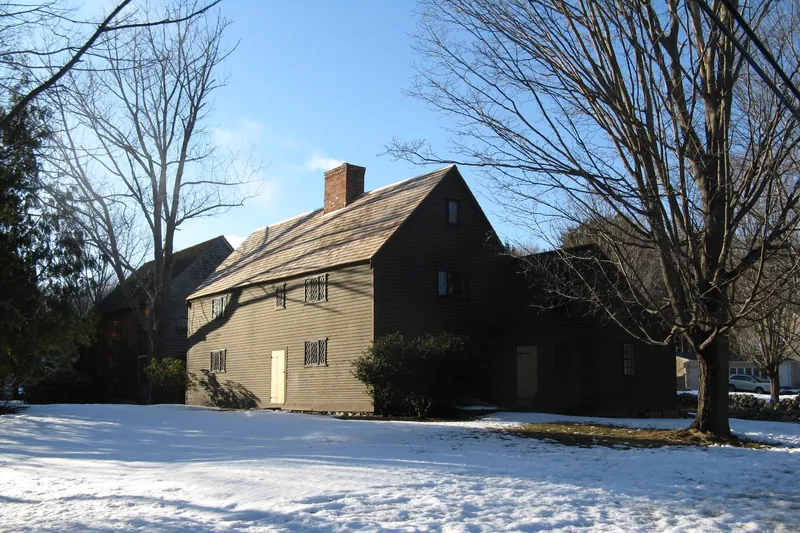
- A Cape with hot water baseboard, an oil boiler in the cellar and a chimney in the middle
- The decision
- Partial-home with backup, or whole-home with no fuel left?
Heating Older Houses · 12 min read · Updated
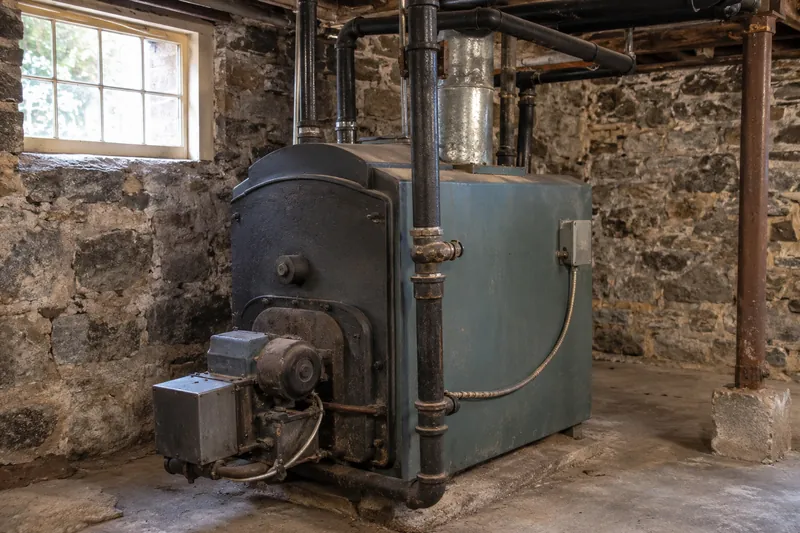
The boiler in a Cape’s basement is usually the most reassuring object in the house. It sits at the foot of the cellar stairs, squat and warm, with a tank along the wall and a chimney connection rising into the brick core of the building. Its burner has come on with the same thump for years. In January, with snow on the bulkhead door, it’s hard to look at that machine and agree to have it hauled away because of a white box on a bracket outside.
That reluctance isn’t foolish. Keeping the boiler is a sensible first choice for some houses, and federal researchers have documented at least one that did it on purpose. But keeping it has costs that are less visible: a second system to maintain, a fuel tank to watch, controls that have to keep two machines from competing, a smaller rebate, and a chimney still doing its job through the center of the house.
So this is a real choice, and it’s one with a date on it. The 2026 Mass Save figures are published for installs through December 31, and they fall on January 1. We’d rather you decide on the merits than on a countdown, but you ought to know both.
Should you keep the oil boiler as backup for a heat pump?
Keep it if it’s in sound shape and the house can’t yet meet the weatherization test; let it go if the shell passes and the load calculation shows the heat pump can carry the coldest night. Heat pumps no longer need the boiler for capability alone. Building America’s ductless guide says many models can heat in cold climates without a backup source, with nearly full capacity well below 0°F. The 99 percent design temperature in Worcester County is 2°F, by ENERGY STAR’s tables. Whether your particular equipment holds up at that point is a matter for the installer’s numbers and the maker’s data, and you should see them.
The case for backup is usually about the house and the owner. There is the Cape that has a heating load no one has measured, or a set of knee walls awaiting attention, or a boiler only a few years old. One Building America case, a house built in 1915, in a cold Pacific Northwest climate, added a multi-head ductless system and left the old boiler for exceptionally cold weather. It’s an old project in a different region, and asbestos around that boiler was part of the reason it stayed, but it shows the pattern is an established one and not a compromise invented by a nervous homeowner.
| Question | Partial-home with oil backup | Whole-home, no fuel left |
|---|---|---|
| What heats the house | Heat pump leads, boiler stays for zones or cold snaps | Heat pump does all the heating and cooling |
| Weatherization | Bonus if done, not a condition | Must meet Mass Save’s test |
| Controls | Integrated control, or old heat disabled in the served area | No second system to coordinate |
| Fuel tank and chimney | Stay, along with their upkeep | Can be dealt with, by the right people |
| If the load is wrong | Boiler can help cover the gap | Comfort depends on the sizing |
What does keeping the oil boiler cost you in rebates?
It cuts the per-ton rebate by more than half, though the bonuses narrow the gap a little. As published for 2026, whole-home pays $2,650 per ton and partial-home $1,125 per ton, both capped at $8,500. Partial-home can add a $500 weatherization bonus and a $500 sizing bonus, the second asking for 90 to 120 percent of the whole house’s heating load on the Manual J sheets.
- Whole-home in 2026$2,650
- Whole-home from January 2027$2,350
- Partial-home in 2026$1,125
- Partial-home from January 2027$1,000
Source: Mass Save 2026 rebate form; Mass Save air source heat pump page for 2027
Take a 3-ton system, as arithmetic only and not a sizing suggestion. That is $7,950 on the whole-home path in 2026, against $3,375 on partial-home, or $4,375 if it earns both bonuses. The Mass Save page says the 2027 figures drop for installs on or after January 1, 2027, with caps of $7,500. There is no federal credit to soften this for a 2026 install, since the IRS says that credit applies to property placed in service before December 31, 2025. The conditions, deadlines and paperwork are in the rebate story, and they’re worth reading before you pick a path.
Whole-home has a gate. The form says the house must be "sufficiently weatherized," meaning built during or after 2000, or an assessment recommending less than $1,000 of weatherization, or recommendations made during or after 2013 having been completed. An older Cape usually gets there by doing the work. See why the upstairs goes wrong for what that tends to involve.
How does a heat pump with oil backup actually run?
It should run with the heat pump in the lead and the boiler waiting behind it, under a control that keeps the two from competing. That is harder than it sounds. In the 2013-14 Building America field study of seven units across Connecticut, Massachusetts and Vermont, monthly performance ranged from 1.1 to 3.1 units of heat per unit of electricity, known as the coefficient of performance or COP. The researchers listed integration with existing heating systems and thermostat setback among the likely reasons for that spread.
For the rebate, Mass Save’s partial-home path calls for an integrated control from its qualified list wherever oil, propane or gas remains in use. Without one, the form says existing heat must be removed or disabled from the area the heat pump serves, and the invoice has to show it. The program also sets a maximum switchover temperature for these controls. We could not confirm the current number, so ask your installer to show it to you.
NEEP’s installer guide suggests an integrated multi-stage control where available, and as a best practice it suggests an outdoor cutout that locks out central heat above a temperature set between 20°F and 35°F, adjusted for comfort. That’s NEEP’s general guidance, separate from the Mass Save limit; a setting in that range may not meet the program’s rule, and if you want the rebate, the program’s number governs. Its consumer guide adds the owner’s half of the bargain: without integrated controls, drop the old system’s thermostat by 5 to 10 degrees so the heat pump leads, then nudge the backup up only when it’s very cold.
Is oil a cheap backup at today’s prices?
Not at the state average posted for early November 2026, on our example numbers, unless the heat pump is having a very bad month. The state’s average retail heating oil price stood at $6.15 per gallon in the week of November 2, 2026, against $3.63 twelve months before. That number will date quickly. Here is the arithmetic, so you can redo it with your own bills.
One gallon of oil holds about 138,500 BTU. At an assumed boiler efficiency of 85 percent, a million BTU of delivered heat takes 8.49 gallons, or about $52. One kWh is 3,412 BTU, so a million BTU is 293 kWh of straight electric heat. At an assumed all-in electric price of 30 cents per kWh, that’s $88, then divided by the heat pump’s COP.
- Heat pump at COP 3.1$28
- Heat pump at COP 2$44
- Oil boiler at assumed 85 percent$52
- Heat pump at COP 1.1$80
Source: Our arithmetic: oil $6.15/gal (week of Nov 2, 2026), EIA and physics conversions, field COP range from Building America; 85% boiler and 30 cents/kWh are assumed
The crossover in that example sits near a COP of 1.7. Change either assumption and it moves. This is not a forecast of your bill. It’s only a way of seeing that the boiler, at this oil price, earns its keep as insurance more than as a bargain. It also means a badly set control that lets the oil run early could quietly cost you money. The running-costs story goes through this with more care, and the rebate form’s warning stands: a heat pump raises household electricity use, often offset by fuel savings, and new cooling raises it again in summer.
A badly set control that lets the oil run early could quietly cost you money.
What has to be true before you let the boiler go?
Four things: the shell is done, the sizing is real, the rooms are all reachable, and you’ve found a new way to do whatever else the boiler does. The shell and the sizing come from the assessment and from a Manual J calculation at your county’s design temperature. Rooms that the heat pump can’t reach are the classic Cape catch. A bedroom with its door shut, a bath under the eave, or a finished basement can each be fine on old baseboard and neglected by a new head, so check how many indoor units the Cape really needs and whether existing ducts could help.
Then look at the rest of the boiler’s job. Does it make your hot water too? If so, you need another plan: Mass Save lists a $750 rebate on qualifying heat pump water heaters. Does a water heater share the chimney? When a boiler leaves, a remaining water heater can be left on a flue that no longer drafts properly, which the orphaned water heater story explains. Does the boiler keep the cellar warm? NEEP cautions that if central heat is the only heat in the basement, it has to run enough in very cold weather to keep pipes from freezing. A whole-home conversion needs a plan for that space, and a basement that drops toward freezing isn’t something to find out in February.
Finally, there’s the tank. Retiring the boiler doesn’t retire it, and no one on this site will tell you to touch it, drain it or cut its lines. Your local fire department is the place to ask about permits. What happens to the oil tank covers the rest.

Can you start with backup and remove the boiler later?
Yes, as a matter of building, and we think it’s a reasonable path for a healthy boiler in an unfinished house. You run a season, watch how often the oil actually fires, finish the weatherization, and then decide with real bills in hand. A winter of low oil use is the best evidence you could have that the boiler has become a spare.
The money side is less friendly. A later change would land under whatever rebates exist then, and the published 2027 numbers are already lower. We also couldn’t confirm how the program treats a house that takes a partial-home rebate and later goes whole-home, so ask Mass Save or your Installer Network contractor before you count on anything. The form limits each customer account to one whole-home rebate. A HEAT Loan can cover heat pumps at 0 percent, with an assessment mandatory on whole-home heat pump projects, and the assessment and loan story has the sequence.
Our own bias: if the boiler is old and the shell can be finished this winter, don’t buy two futures. Weatherize, go whole-home, and get the boiler and its tank out of the way properly. If the boiler is recent, there’s less hurry, and using it as backup while you work on the house is good sense.
A sound boiler in an unweatherized Cape is a fair reason to keep oil for now. An old boiler in a house that can pass the test is not, and we’d let it go.
What it comes down to
- If Your house meets the weatherization test and Manual J covers 2°F with every room reached
- Then Go whole-home and retire the oil properly
- If Your boiler is sound but weatherization isn’t finished
- Then Go partial-home with an integrated control, and finish the shell
- If The boiler is failing and the shell is far from ready
- Then Get the assessment now, before replacing it like for like
- If The boiler also makes hot water or shares a chimney
- Then Plan the water heater and venting before removal, with a pro
- If You’re counting on 2026 figures
- Then Confirm the install can finish by December 31 and the paperwork by February 28, 2027
Also asked
Do I have to remove the boiler to claim a whole-home rebate?
The published rule makes the heat pump the home’s only heating and cooling, and a signed verification form is part of it. We couldn’t confirm exactly what the program demands for a boiler left disconnected in place. Ask your contractor to get that answer in writing before you sign.
Should I shut the heat pump off when it’s bitterly cold and use the boiler?
NEEP’s consumer guide says not to shut a heat pump off in very cold weather, and to turn it up a bit if anything. If a control is switching over for you, have the installer explain the setting. Don’t override it on instinct.
What about a power outage?
Both systems need thinking about, and a generator or backup plan is a job for a licensed electrician. Ask your heating contractor what your boiler needs to run in an outage before assuming that it’s a true emergency heat source.
Do I still need oil deliveries if I barely use the boiler?
You need enough fuel to keep the backup useful, and no more than your use justifies. Ask your oil company and service tech how they treat a low-use tank, including service and any automatic delivery plan. Those details are worth settling before the first winter.
Where this comes from
- 2026 rebate form, National Grid copy: rebate amounts, bonuses, weatherization test, integrated control rule, electricity warning
- Mass Save page on air source systems: only-heat-source rule, switchover limit, 2027 figures
- Federal ductless heat pump guide: cold-climate capability without backup
- ENERGY STAR county design temperatures: Worcester County design temperature
- Building America case study, retrofit of a 1915 home: ductless heat with boiler kept for extreme cold
- Building America cold-climate field monitoring: 2013-14 COP range and likely causes
- NEEP installation guidance: integrated controls and outdoor cutout
- NEEP advice for owners: running a backup, basement freeze caution, cold-weather operation
- Massachusetts home heating fuel prices: oil price for the week of November 2, 2026
- EIA, British thermal units: heat content of heating oil
- IRS, Energy Efficient Home Improvement Credit: credit end date
- Mass Save water heater offer: the $750 rebate
- Mass Save financing: HEAT Loan terms and assessment requirement
- State alarm requirements: CO alarm rules and what to do when one sounds