Keeping the Radiators: Hot Water, Steam and Heat Pumps
A heat pump with radiators is realistic only on a hot-water system, and only if a designer shows each room stays warm at lower water temperatures. Steam can’t take one directly, so we’d keep the radiators and add ductless heads.
- The house
- A two-story Central Massachusetts Colonial with cast-iron radiators under the windows and old pipe across the basement ceiling
- The decision
- Keep the radiators, replace them, or run both?
Heating Older Houses · 12 min read · Updated
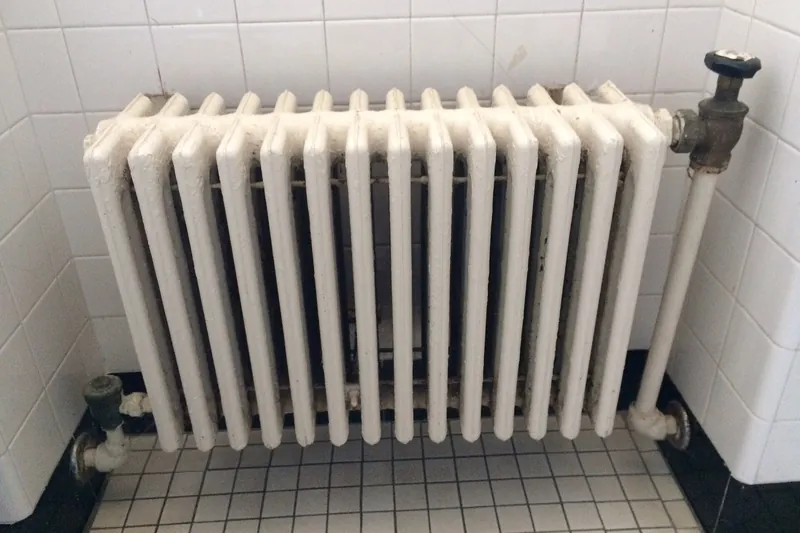
On a January morning, the front hall of an old Colonial tells you how the place is heated. Something ticks in the wall. A radiator under the stair window, thick with decades of paint, gives off the dry, even warmth that nothing installed since has quite matched. Follow the pipe down and the basement ceiling is a map of a century’s decisions: mains wrapped in white, branches added by someone long gone, a boiler sitting at the center of it all.
Then the heat pump conversation arrives, usually in the form of a bid, and it tends to treat those radiators as an obstacle. The installer sees a house with no ducts and proposes wall-mounted heads. A neighbor says you can run a heat pump straight into the old radiators. Someone else says you can’t. All three are partly right, because the answer depends on what actually moves through the pipes, and that is the first thing to find out.
Most Colonials should keep the radiators. On a hot-water system, air-to-water may be worth a proper design study. On steam, the sensible first move is to add ductless heads and leave the radiators and boiler to cover the coldest days. Taking cast iron out of the house is the option we’d reach for last.
Is your Colonial on hot water or steam?
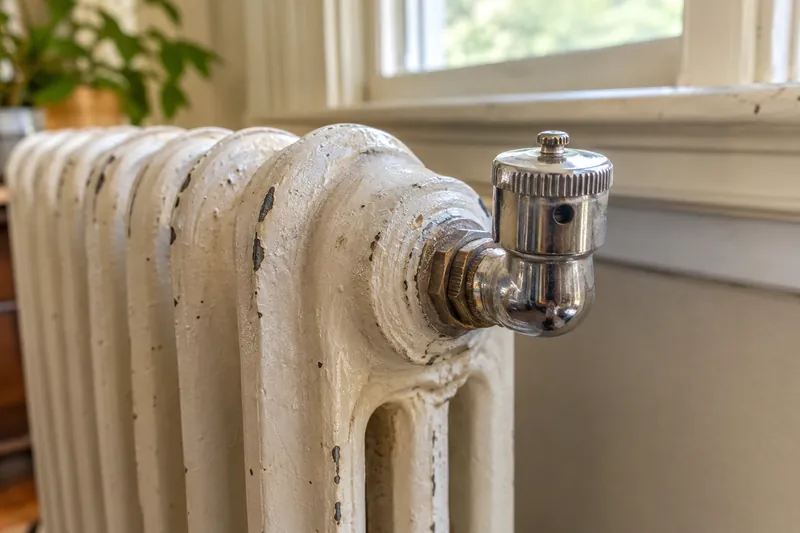
You can usually get a strong clue by looking, without touching anything. A radiator fed by one pipe, with a small air vent on its side, points to one-pipe steam, the arrangement Pacific Northwest National Laboratory describes as common in older buildings, especially those built before 1970. The same guide says two-pipe steam returns its water through a second pipe and relies on steam traps.
A radiator with two pipes and no side vent could therefore be two-pipe steam or hot water, and looks alone won’t settle it. The person who services your boiler can tell you on the next visit, and that is the right way to confirm it. Ask them to write it on the service ticket, because every bid that follows will depend on it. Plenty of old houses have also been altered along the way, so an answer given for one neighbor’s house says little about yours.
Can a heat pump with radiators run on hot water?
Sometimes, and the test is arithmetic rather than opinion. Heat pumps built to heat water, drawing from outdoor air or from another water loop, generally reach about 110 to 140 degrees, according to Department of Energy slides that describe them as suited to low-temperature hydronic systems. Hydronic simply means heat carried by water. The question for your house is whether each radiator, at whatever water temperature the machine would really deliver, can hold its room on the coldest hours of the year.
Those hours are not hypothetical here. The ENERGY STAR design temperature guide puts Worcester County’s 99 percent heating design temperature at 2 degrees, meaning it gets colder than that for only about 88 hours in a typical year. Middlesex County sits a degree lower still, and Boston’s airport is a good deal milder, which is one reason advice written for the coast can flatter a job inland.
- Middlesex County1°F
- Worcester County2°F
- Suffolk County (Boston Logan)12°F
Source: ENERGY STAR design temperature guide
So a real proposal shows two things, room by room: the heat the room loses at the design temperature, and what the radiator in that room puts out at the planned water temperature. We can’t give you a rule of thumb for old radiators, and you should be wary of anyone who offers one in place of a calculation. Radiators sized in another era, for a leakier house, may have room to spare or they may not. If a bid says "your radiators will be fine" without numbers behind it, it hasn’t answered the question. Our guide to reading a heat pump bid covers what a sizing calculation should look like on paper.
Air sealing and insulation change those sums. The Department of Energy notes that cold-climate heat pump retrofits often need air sealing first, and a tighter house asks less of every radiator, so we’d book the weatherization work before the design study, not after it. Be aware that combustion safety checks belong to a professional after any air sealing while the boiler is still in service.
Air-to-water also has a rebate. As published for 2026, Mass Save lists $2,650 a ton, capped at $8,500, matching an air-source whole-home job, with the same installer network, product list and weatherization test, and a lower figure for installs from January 1, 2027. The details live in our rebate story. Ask any installer proposing this how many such systems they have put into houses with existing radiators, and ask to hear how those rooms held up in a cold snap.
Why can’t steam radiators take a heat pump?
Because a steam system runs on steam, and water that tops out around 140 degrees isn’t steam. That is our own plain reasoning rather than a quoted ruling, and a heating designer is the one who decides what is possible in a given house. But the logic is hard to get around. The radiators in a steam house are waiting for a gas that a boiler has to make, and the heat pumps described above don’t make it.
This is the part of the sales conversation to listen to carefully. Converting a steam house to low-temperature hot water is a different and much larger project than swapping a machine in the basement, involving the pipes, the radiators and possibly the walls. If someone proposes it, you want a designer’s drawing and a written account of which pipes stay, which go, and what happens to any insulation on them along the way.
For most steam houses, then, the near-term decision is simpler than it first appears. The steam system stays for now, and the heat pump goes in alongside it. Keeping steam means keeping it in tune, too, because PNNL notes that steam reaches radiators at about the same time only when the air vents on the headers, risers and radiators are properly sized and working. A house that heats unevenly on steam may be telling you something a technician can fix before you spend money on anything else.
What does running both look like in a Colonial?
It looks like heat pumps doing most of the ordinary winter while the radiators wait for the bad nights. ENERGY STAR lists older homes with radiators and no ductwork among the good fits for ductless systems, in which an outdoor unit feeds one or more heads inside. A Building America case study of a 1915 house took this route, with a multi-head ductless system complementing the hydronic heat and the boiler left for extreme cold. That house was in the Pacific Northwest, so treat it as a demonstration of the layout rather than a forecast for Worcester.
A Colonial suits the arrangement in some ways and fights it in others. Two full floors with a stairwell in the middle mean a head downstairs is unlikely to look after four bedrooms with their doors shut, so expect the design to treat the upstairs on its own terms. NEEP’s consumer guide asks owners to leave doors open wherever a room has no unit, which is advice some bedrooms will ignore. A house with radiators has an advantage here, since a closed room still has its own heat on the coldest nights.
How you run the two matters as much as what you buy. NEEP’s advice is to set the heat pump and leave it, and to set the old system’s thermostat 5 to 10 degrees under where you normally keep it, so the heat pump leads. Deep setbacks may cost energy. Winter field monitoring from 2013-14, across Connecticut, Massachusetts and Vermont, measured heat output per unit of electricity, month by month, at a low of 1.1 and a high of 3.1, and the authors tied the wide spread to low indoor airflow, badly placed outdoor units, warm return air and thermostat setback. It is an old study, but the lesson has aged well: much of the performance is in the setup and the habits.
Mass Save’s partial-home rebate, as published for 2026, is written for this kind of house, at $1,125 a ton with an $8,500 cap. The form calls for an integrated control in zones that keep burning oil, propane or gas. An integrated control is the device that decides which system runs, and it has to come from the program’s approved list. Without one, the old heat has to be taken out or disabled wherever the heat pumps now serve, and the invoice has to say so. Think that through before you sign, since "disabled" in a radiator house is a plumbing question for your installer.
A house with radiators has an advantage here, since a closed room still has its own heat on the coldest nights.
Would we ever take the radiators out?
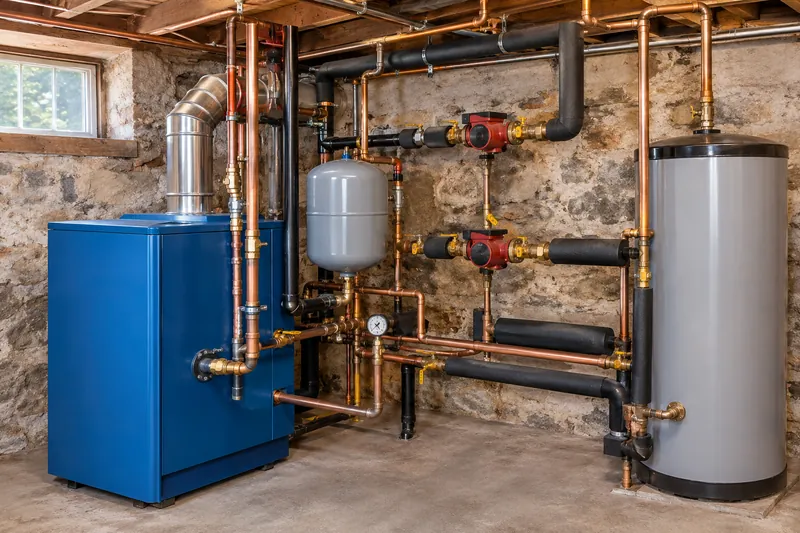
Rarely as a first step, and rarely for comfort alone. Radiators come out when a floor plan demands it or when the whole system has already been retired, and removal is the point at which an old house’s hazards tend to wake up. Moving cast iron means disturbing paint on the radiator and the wall behind it, and pipes that have sat quietly under old insulation for decades start getting cut.
There is also no rush. A drained radiator can usually wait, and some owners may prefer to leave them disconnected and in place for a few years before making a permanent decision, though your installer should explain how the system is drained and capped so that nothing surprises you later. That work is theirs, not yours.
Going fully to heat pumps with no boiler is a legitimate choice, and on the published 2026 terms it brings the higher whole-home rate. It requires the heat pump to be your sole source of heat and cooling, and it sets off a chain of other jobs. An oil-fired boiler leaves a tank behind. A water heater sharing the chimney is left with a venting problem that needs a professional’s plan before the boiler goes. Those aren’t reasons to refuse. They are reasons to price and schedule the whole sequence at once, and to weigh it against a boiler you could simply keep. If you also want summer comfort, heads installed for heating do the work described in our piece on cooling a house with no ducts.
| Your system | Air-to-water heat pump | Ductless heads alongside | Our first move |
|---|---|---|---|
| Hot water, boiler in good shape | Possible if the room-by-room numbers work | Works, boiler covers extreme cold | Weatherize, then ask for both designs |
| Hot water, boiler near the end | Worth a serious design study now | Works, but you still need a boiler or a full plan | Get the design before the boiler fails |
| One-pipe or two-pipe steam | Not directly, as we reason it; designer decides | Works, steam stays as backup | Tune the steam, then add heads |
What it comes down to
- If Your system is hot water and a designer’s numbers show each room holding at the 2-degree design day
- Then Get an air-to-water proposal priced alongside a ductless one
- If Your system is hot water but nobody will put radiator output in writing
- Then Treat air-to-water as unproven for your house and go with ductless heads and the boiler
- If Your system is steam
- Then Keep the radiators, have the steam system tuned, and add ductless heads for most of the winter
- If The boiler is failing this winter
- Then Get a designer in before an emergency replacement closes off your choices
- If You want the radiators gone for floor space
- Then Budget for lead and asbestos work first, and treat it as a renovation rather than a heating job
Also asked
Will my rooms feel different with heads instead of radiators?
They probably will, since a head moves warm air and a radiator warms the room more gently and stays warm after it shuts off. Running both lets you keep some of that feel on cold days. Sit near a working head in a friend’s house before you commit, if you can.
Can I keep just the upstairs radiators?
That depends on how your piping is laid out, and the rebate paperwork treats any heating left in an area served by heat pumps according to its own rules. Ask the installer to show on the plan which radiators stay live and which control governs them.
Should I replace an old boiler before adding a heat pump?
Not automatically. If it is safe and working, add the heat pump first and let the boiler run less. Have the existing boiler serviced and checked by a professional, and make the replacement decision once you’ve seen a winter of the new arrangement.
Do thermostatic valves help on steam radiators?
They can, and PNNL’s guide explains that on one-pipe steam the valve sits on the vent side rather than the inlet. Have your heating technician advise and fit them, and ask how they would interact with the heat pump’s control.
Where this comes from
- Pacific Northwest National Laboratory, thermostatic radiator valves on steam: how one-pipe and two-pipe steam systems are recognized and why vents matter
- U.S. Department of Energy, HVAC retrofit slides: the 110 to 140 degree water range for air-to-water and water-to-water heat pumps
- ENERGY STAR Design Temperature Limit Reference Guide: county design temperatures
- Mass Save air-to-water heat pumps: rebate terms as published for 2026
- The 2026 rebate form, as posted by National Grid: partial-home rate and integrated control rules
- ENERGY STAR on ductless systems: radiator houses as a good fit
- Building America 1915 house case study: ductless heads complementing hydronic heat
- Building America cold-climate field study: 2013-14 efficiency range and likely causes
- NEEP consumer guide: operating a heat pump with backup heat
- U.S. Department of Energy on building envelopes and heat pump installs: why sealing tends to come first
- State Fire Marshal guidance on alarms: where they go and what to do